
Duct leakage testing
We pressurise each section of ductwork and measure how much air it loses, so you know it meets the leakage class in your specification before the ceiling closes.
- Proves
- Each section leaks less than its class allows
- When
- After installation, before insulation and ceilings
- Method
- SMACNA HVAC Air Duct Leakage Test Manual
- You get
- A signed report with a pass or fail per section
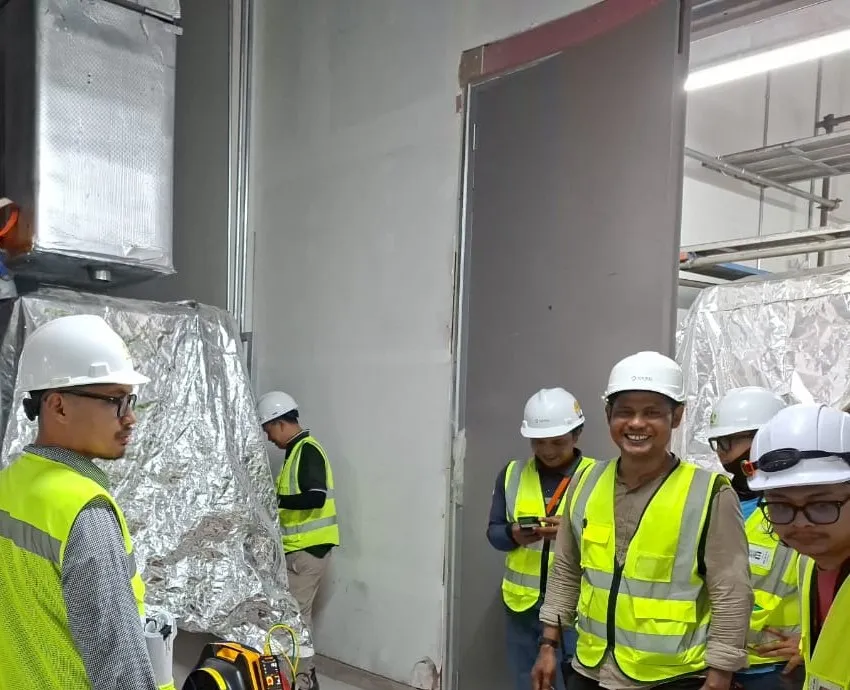
What the test proves
Leaky ductwork wastes fan energy and sends less air to the rooms it was sized for. In a battery room or data hall, that air is the cooling the equipment depends on.
The test measures the airflow needed to hold a sealed section at the test pressure. That figure is the section's leakage. We compare it with the limit for its leakage class, and the section passes or fails.
Test before the joints disappear
Leaks are cheap to fix while the ductwork is bare and the scaffold is up. Once insulation and ceilings go in, every repair means opening them again.
Ductwork installed
Sections are hung, supported and joined.
Leakage test
Every joint is still visible and within reach. This is where we come in.
Insulation fitted
Joints are wrapped and hard to inspect.
Ceilings closed
A repair now means opening the ceiling.
Commissioning
Airflow is balanced and the system is handed over.
Before we arrive
Send this list to your site team. A section that is ready on the day is a section that gets tested on the day.
Ductwork complete and supported
Every section in the test is installed, hung and sealed at the joints.
Openings capped
Grilles, diffusers and open branch ends are blanked off so the section holds pressure.
Sections and test pressure agreed
Test sections are marked on the drawings, with the leakage class and test pressure from the specification.
Safe access to the test point
Scaffold or ladder in place at the connection point, with work permits issued.
Power and witnesses
A 230 V socket near the test point, and your commissioning agent invited to watch.
What the report includes
Every test ends with a signed report, ready to attach to the commissioning record. Your commissioning agent gets the same copy you do.
Ask for a sample report
Duct leakage test report
- 1Project, systems and test sections, with a drawing extract
- 2Test method, test pressure and leakage class
- 3Readings and result for each section
- 4Retests for any section that failed
- 5Photos of each test setup
- 6Equipment serial numbers and calibration dates
- 7Signatures of the tester and witnesses
Questions contractors ask
What happens if a section fails?
We help find the leak, usually at a joint, seam or access door. Your contractor seals it and we retest the section, on the same visit where the schedule allows.
Which standard do you test to?
The SMACNA HVAC Air Duct Leakage Test Manual, unless your specification names another method. We confirm the method, test pressure and leakage class before the test date.
Can you test ductwork that is already insulated?
Yes, the test still measures leakage. But if a section fails, finding the leak means removing insulation, so we recommend testing before it goes on.
How many sections can you test in one visit?
It depends on section size, access and how ready each section is. Once we have seen the drawings, the test plan gives you an estimate.
Other tests we run
Book a duct leakage test
Send the drawings, the specification and your target dates. We reply with a test plan and a quote.