
Room integrity testing
We fit a door fan into the room's doorway and measure how much air escapes. From that we predict how long the room will hold its suppression agent, with no gas discharged.
- Proves
- The room holds its agent for the full hold time
- When
- Before handover, and after any work on the room
- Method
- Door fan test to ISO 14520 or NFPA 2001
- You get
- A signed report with the predicted hold time
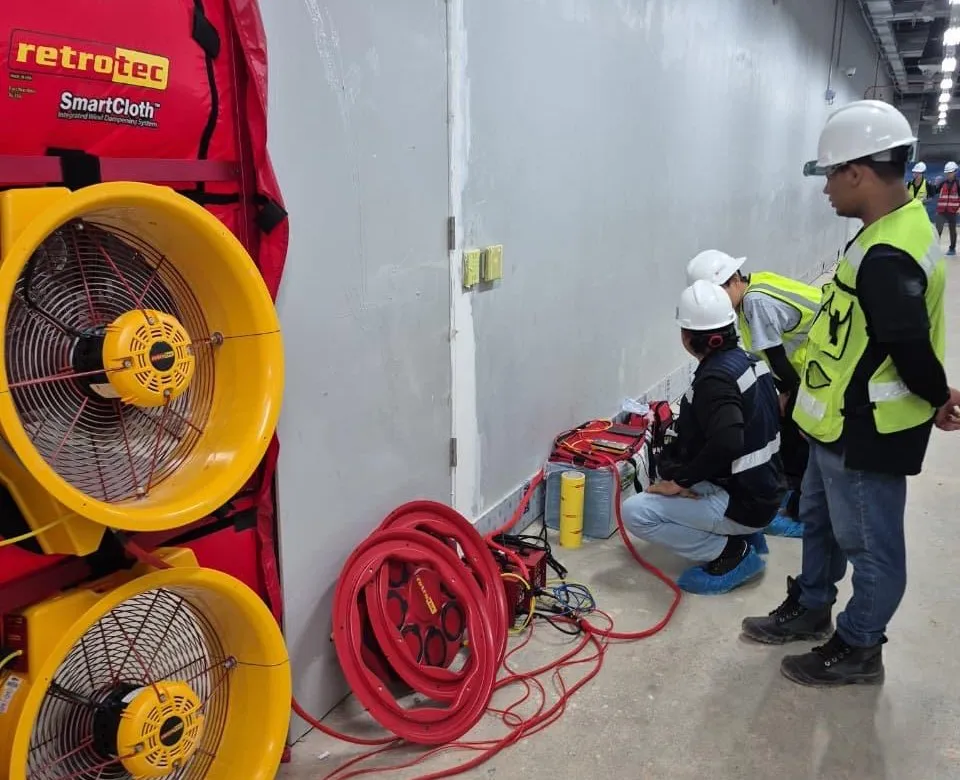
What the test proves
A gas suppression system puts out a fire by holding its agent in the room. Gaps in the walls, doors or ceiling let the agent drain away, and nobody sees it until the day of a fire.
The door fan measures the room's total leakage at a set pressure. From that, the room size and the agent, we predict the hold time and compare it with the time your design needs.
Test once the room is sealed
The result only counts once the walls, ceiling, doors and penetrations are final. Test too early and the next trade drills a new hole.
Room sealed
Walls, ceiling, doors and penetrations are finished.
Integrity test
The room is final and every leak is still easy to reach. This is where we come in.
System handover
The suppression system is commissioned and the room goes live.
New cables and pipes
Each new hole through a wall is a new leak path.
Yearly check
The room is inspected each year and retested if anything changed.
Before we arrive
Send this list to your site team. A room that is ready on the day is a room that gets tested on the day.
Room construction complete
Walls, ceiling, raised floor and doors are installed, and every penetration is sealed.
HVAC set as it would be in a fire
Dampers that close on discharge are shut, and fans that stop on discharge are off.
Room and agent details
Room volume, agent type, design concentration and hold time, from your suppression designer.
A doorway for the door fan
One door that opens onto a larger space, kept clear while the test runs.
Power and witnesses
A 230 V socket near the door, and your commissioning agent invited to watch.
What the report includes
Every test ends with a signed report, ready to attach to the commissioning record. Your commissioning agent gets the same copy you do.
Ask for a sample report
Room integrity test report
- 1Room boundaries, volume and agent details
- 2Test method, standard and door fan setup
- 3Measured leakage at test pressure
- 4Predicted hold time against the design requirement
- 5Leak locations found, with photos
- 6Equipment serial numbers and calibration dates
- 7Signatures of the tester and witnesses
Questions contractors ask
What happens if the room fails?
We help find the leaks, often at cable penetrations, door seals or the ceiling void. Your contractor seals them and we retest, on the same visit where the schedule allows.
Which standard do you test to?
ISO 14520 or NFPA 2001, whichever your suppression design follows. We confirm it, with the agent and hold time, before the test date.
Do you discharge any gas?
No. The door fan uses air only, so there is no agent to refill and no downtime for the room.
How often should the room be retested?
NFPA 2001 asks for a yearly inspection, with a retest if anything has changed. A new cable through a wall counts as a change.
Other tests we run
Book a room integrity test
Send the room drawings, the suppression design and your target dates. We reply with a test plan and a quote.