
Data center commissioning levels 1 to 5, and which tests happen at each
Data center projects commonly run commissioning in five levels: factory witness tests at Level 1, delivery and installation inspection at Level 2, pre-functional checks and start-up at Level 3, functional performance tests of each system at Level 4 and integrated systems tests at Level 5. Duct leakage, electrical dead tests, room integrity and TAB all have to be finished before Level 4 starts, so they are booked against the installation programme rather than the commissioning dates.
The five levels at a glance
Each level proves something the next one depends on, so a gap at one level tends to surface as a delay at the next. The names below are the ones most data center projects use, though the project's commissioning plan governs what each level contains.
| Level | What happens | Tests that belong here |
|---|---|---|
| Level 1 | Factory witness tests, with equipment tested at the manufacturer's works before it ships | Factory acceptance tests on chillers, generators, UPS systems and switchgear |
| Level 2 | Delivery and installation inspection, with equipment checked on arrival and installed to the drawings | Installation checks, pipework pressure tests and duct leakage tests on finished sections |
| Level 3 | Pre-functional checks and start-up, with each unit checked and run for the first time | Insulation resistance and earthing before energisation, manufacturer start-up, remaining duct leakage tests, room integrity and TAB |
| Level 4 | Functional performance tests of each system on its own | Mechanical tests at each load step, duty and standby changeover, control sequences |
| Level 5 | Integrated systems tests, with all systems running together | Simulated failures such as loss of utility power or a cooling unit tripping, with the hall under load |
Where each test sits
Pariksa works as a testing firm inside the commissioning agent's plan, and each of our five tests has a window set by the construction sequence rather than by the level numbers alone:
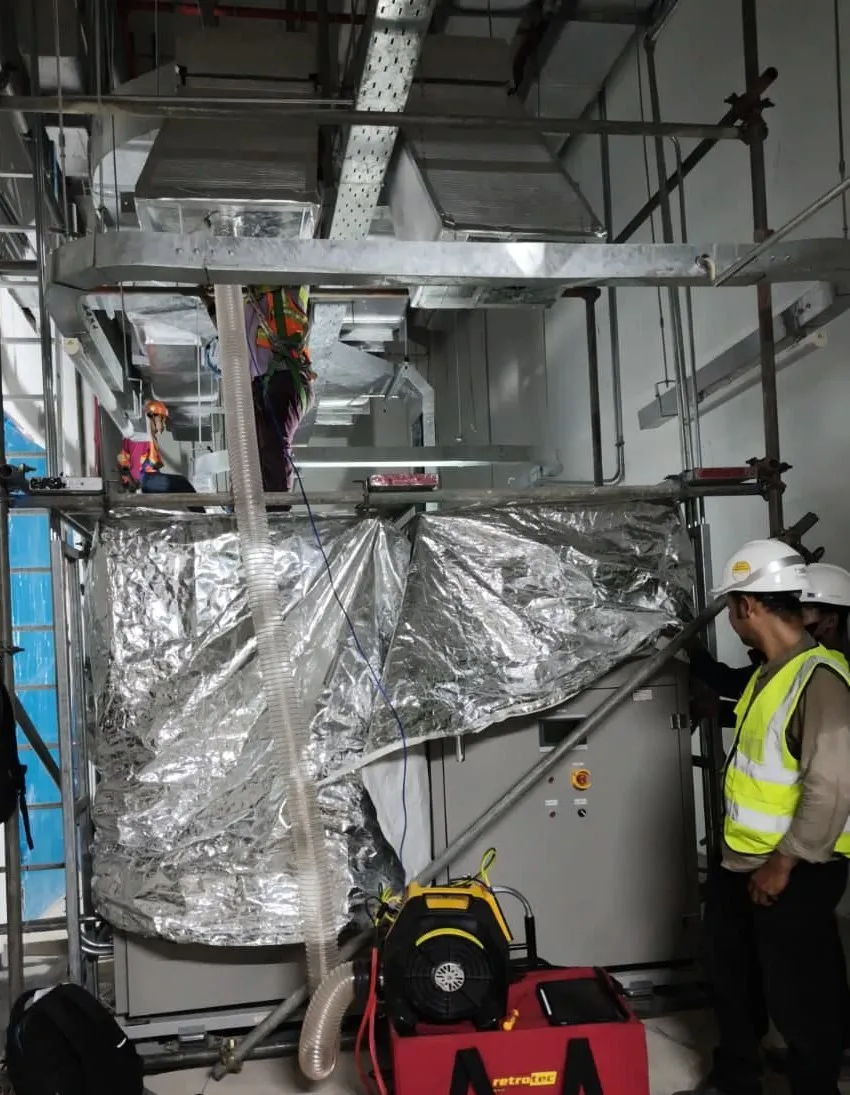
- Duct leakage testing happens during installation, before insulation goes on and ceilings close, which makes it Level 2 to 3 work done section by section as the ductwork is finished.
- Electrical acceptance tests such as insulation resistance and earthing are dead tests, so they are done at Level 3 before each board or system is energised.
- Room integrity testing needs the room fully sealed, and it has to pass before the suppression system is accepted.
- TAB comes before functional tests, because Level 4 judges each system against its design duty and that judgement only holds once air and water flows are balanced.
- Mechanical tests at each load step are Level 4 work, proving that chillers, CRAH units, pumps and fans deliver their design duty.
Booking tests so Level 4 starts on time
The earlier tests have windows that close, and once a window has passed the test becomes slower and more expensive to do. Duct leakage testing gets harder once insulation is on, room integrity has to be repeated if a later trade cuts a new penetration, and balancing done before the controls work is undone when the setpoints change.
The practical approach is to book each test against the installation programme, as soon as the dates for insulation, room close-up and system start-up are known, rather than waiting for the commissioning agent to call for Level 4. That way the results are signed and filed before the functional test scripts begin.
Who does the work at each level
The commissioning agent writes the commissioning plan, approves the test scripts, witnesses the tests and signs off each level. The tests themselves are carried out by the manufacturers, the installing contractors and specialist testing firms, each working to scripts and method statements the commissioning agent has approved.
A testing firm such as Pariksa runs the measurements, records the readings against the specification and hands a signed report to both the contractor and the commissioning agent, while the decision that a level is complete stays with the commissioning agent.
Why levels differ between projects
Levels are a convention rather than a fixed standard, so two projects can place the same test at different levels. One plan may count TAB as Level 3 and another as the first part of Level 4, and owners with their own commissioning standards often add tests or hold points of their own.
Before booking any test, check the commissioning plan for the level it sits in and the hold point it has to clear, since that is what the commissioning agent will sign against.
Questions about commissioning levels
What is the difference between Level 3 and Level 4?
Level 3 proves each unit is installed correctly and starts and runs safely, while Level 4 proves each system does its job at design duty and through all its control sequences. A chiller can pass Level 3 with no alarms and still fall short of its capacity at Level 4.
What is an integrated systems test?
It is the Level 5 test, where all systems run together and the commissioning agent simulates failures such as loss of utility power or a cooling unit tripping. It shows that the facility keeps the hall within its limits and recovers as designed.
Why do some projects use Levels 0 to 6?
Some owners and commissioning agents add a level before factory testing, usually for design review, and one after handover. The numbering is a convention, so the project's commissioning plan says what each level covers.
Who leads each level?
The commissioning agent leads every level by setting the scripts and witnessing the tests. Manufacturers run Level 1, installing contractors and testing firms run Levels 2 and 3, and Levels 4 and 5 are run by contractors and testing firms under the commissioning agent's direction.
What most often delays Level 4?
Tests that were not booked early enough, such as duct leakage tests left until after the ducts were insulated, or balancing that is not finished when the functional tests are due to start.
Book testing for your next project
Send the drawings, the specification and your target dates, and we'll reply with a test plan and a quote.