
TAB measures and sets the air and water flows so each unit, coil and terminal gets its design flow, while commissioning proves that the whole installation works as the owner needs, in every mode and under control. TAB is done by a testing and balancing firm and comes first, because functional tests assume the flows are already right, and the commissioning agent then reviews the TAB report, spot-checks a sample of readings and goes on to witness the functional tests.
The difference at a glance
On site the two words are often used as if they meant the same thing, partly because both involve instruments, test sheets and a witness. They answer different questions, are done by different people and produce different documents:
| TAB | Commissioning | |
|---|---|---|
| What it answers | Is the right amount of air and water reaching each unit, coil and terminal? | Does the installed system do what the owner needs, in every mode and under control? |
| Who does it | A TAB firm, ideally independent of the installer | The commissioning agent, who plans, witnesses and records, with the contractors operating the equipment |
| When | After installation, leakage testing and start-up, before functional tests | From design review and factory tests through to integrated systems tests and handover |
| What it measures | Flow, pressure, speed and power at fans, pumps, coils and terminals | Sequences, alarms, failover, control response and system performance |
| What it produces | The TAB report, with design and measured flow at every point | Test scripts, witnessed results, an issues log and the commissioning report |
Why TAB comes first
Functional tests assume the system is already balanced. A functional test of a CRAH unit checks that it ramps its fan, opens its chilled water valve and holds its supply air temperature as load changes, and if the coil is starved because a balancing valve upstream was never set, the unit fails for a reason that has nothing to do with its sequence. Failover tests work the same way, since the response of the hall when a unit stops depends on how the remaining units and coils share the flow, and on an unbalanced system the result describes the distribution rather than the controls.
TAB also hands the controls engineer values that the sequences depend on, such as the pump differential pressure that still delivers design flow to the furthest coil or the fan speed that delivers design airflow with clean filters. Running TAB first means each functional test failure points at the thing being tested, which keeps the issues log short and the retests few.
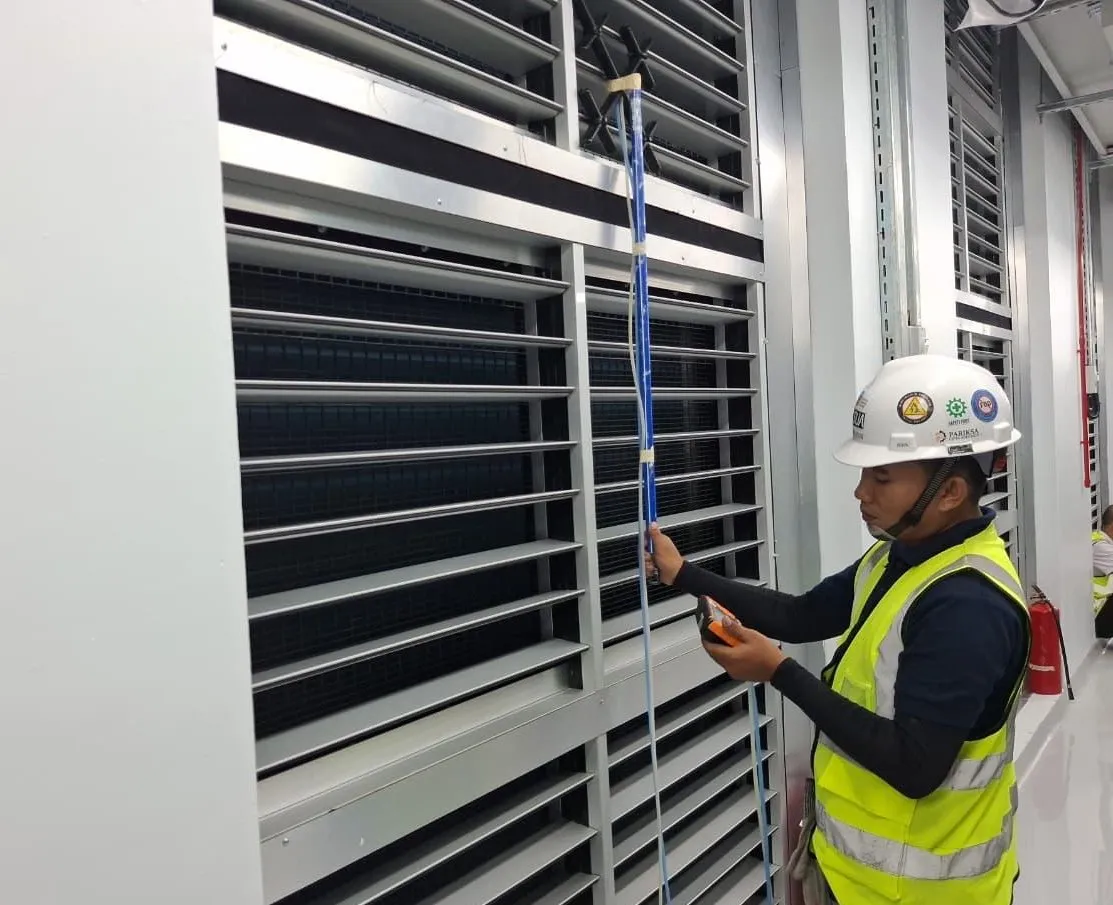
What the commissioning agent does with TAB results
The commissioning agent does not repeat the TAB work. Their first job is a desk review of the report against the design flow schedule, checking that every terminal appears, that each instrument has a current calibration, that every reading outside tolerance is explained and that the total at each fan and pump agrees with the sum of its branches. They then confirm a sample of readings on site, and if those spot-checks do not agree with the report, the system goes back for rebalancing before functional tests can start.
Why independence matters
A tester who did not install the system has no reason to adjust the numbers. When a mechanical contractor balances its own work, a branch that cannot reach design flow because of an undersized duct or a pump selected short of duty is a defect in its own installation, and the pressure to write down a passing figure is real even when nobody intends it. An independent tester records the reading as measured, traces the cause and leaves the decision on the remedy to the design team and the owner, which gives the commissioning agent a report it can rely on.
This is also why Pariksa works as a testing company and not as the commissioning agent. We measure, adjust and report, and the commissioning agent reviews our report, witnesses the readings it chooses and signs off.
Sorting out the scope in the contract
Most arguments on site come from scopes that overlap or leave gaps between contracts, so it helps to write down who does what before the first TAB visit. A clear split usually looks like this:
- TAB firm: writes the TAB plan, measures and adjusts every flow, and issues the TAB report
- Mechanical contractor: makes each system complete, clean and running, gives access to dampers and valves, and fixes defects the TAB finds
- Controls contractor: provides overrides during balancing and sets control setpoints from the TAB results
- Commissioning agent: reviews the TAB plan and report, spot-checks readings, and runs and witnesses the functional tests
- Design engineer: decides how to resolve any terminal or coil that cannot reach design flow
Questions about TAB and commissioning
Can the commissioning agent do the TAB work?
It can be contracted that way, but it removes a check, because the party meant to review the TAB report would then be reviewing its own readings. Keeping the two roles with separate firms keeps the agent's spot-checks a genuine verification.
Should the TAB firm be independent of the mechanical contractor?
Ideally the TAB firm is appointed by the owner or the main contractor rather than as a subcontractor of the mechanical contractor. Where it does sit under the mechanical contractor, the specification can still require the commissioning agent to witness the work and spot-check the report.
Does the commissioning agent re-measure TAB readings?
Only a sample, not every reading, and the commissioning plan or specification sets the size of the sample. Agents tend to choose the furthest terminals, the largest units and any reading close to the edge of tolerance, usually with the TAB technician present using the same instruments.
Is TAB a prerequisite for functional testing?
Yes, an accepted TAB report is normally one of the entry conditions for Level 4 functional performance tests, together with completed pre-functional checklists. The commissioning plan lists the exact conditions for each system.
What causes TAB to hold up closeout?
Systems that are not complete or not clean, such as missing dampers, dirty filters or pipework not yet flushed, controls that cannot yet hold fans and pumps at a fixed speed, and access closed off by ceilings or racks before the dampers and valves were set. Each one forces a return visit, and late changes to a system mean that part of the TAB has to be repeated.
Book testing and balancing
Send the drawings, the flow schedule and your target dates, and we'll reply with a test plan and a quote.