
Room integrity testing for FM-200 and Novec 1230 rooms: what the door fan test proves
A room integrity test proves that a room protected by FM-200 or Novec 1230 will hold its agent long enough to put out a fire, which NFPA 2001 sets as at least 85% of the design concentration at the height of the highest protected equipment for 10 minutes, or long enough for trained people to respond. A door fan pressurises the room, measures how much air escapes and turns that leakage into a predicted hold time, so the room is proven without discharging any gas.
What the test proves
A clean agent system such as FM-200 or Novec 1230 puts out a fire by filling the room with agent at its design concentration and keeping it there, so the cylinders and nozzles are only half of the system and the room itself is the other half. NFPA 2001 expects the room to hold at least 85% of the design concentration at the height of the highest protected equipment for 10 minutes, or for as long as trained people need to respond, and the time a room actually manages is its hold time.
A room that leaks through unsealed cable penetrations or an open ceiling void loses agent faster than the design assumes, and nobody finds out until the day the system discharges. The room integrity test answers the question before handover by comparing the room's predicted hold time with the time the suppression design requires, which gives the commissioning agent a clear pass or fail to witness and sign.
How the door fan measures leakage and predicts hold time
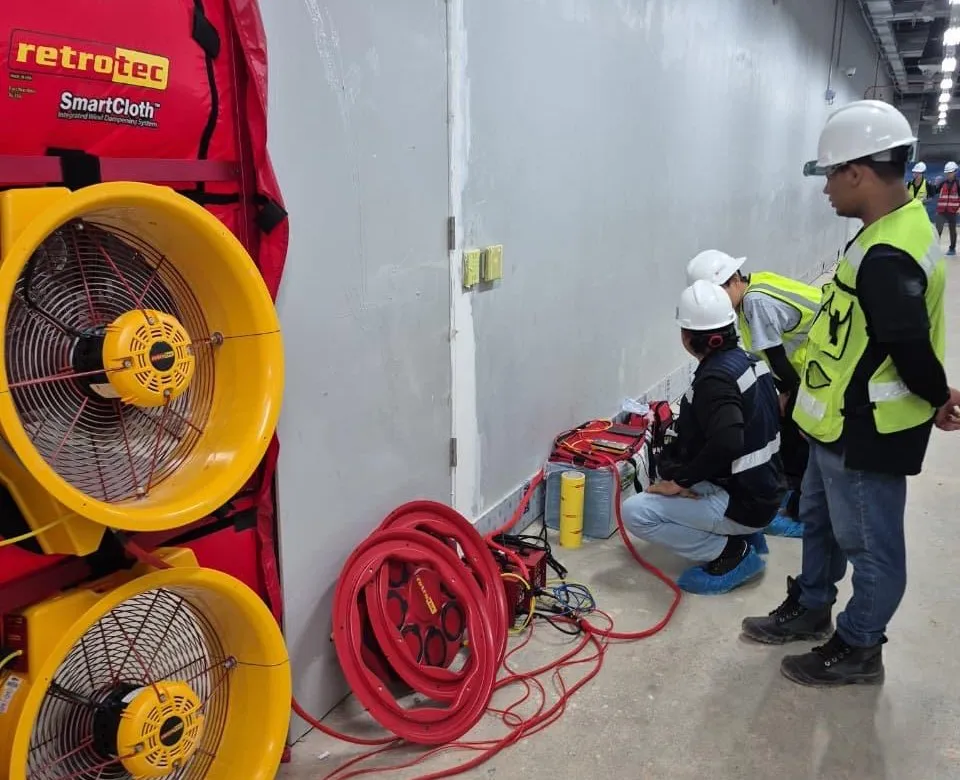
The door fan is a calibrated fan fitted into a doorway inside an airtight panel, and it blows air into or out of the room until it holds a steady pressure difference across the room's boundary. The airflow needed to hold that pressure is the room's leakage, and from readings at several pressures the tester works out the equivalent leakage area, which is the size of one hole that would leak as much air as all the real gaps together.
FM-200 and Novec 1230 mixed with air are heavier than air, so after a discharge the mixture escapes through low gaps while fresh air enters through high ones, and the boundary between agent and air sinks down the room. The door fan method in Annex C of NFPA 2001 uses the leakage area, the room's volume and height, the agent and its design concentration to predict how long that boundary takes to fall to the top of the highest protected equipment, and that time is the predicted hold time. Where fans keep the room mixed during the hold, the prediction follows the falling concentration of the whole room instead.
Why the test uses air instead of agent
A discharge proves the room only at the moment it happens and only as a concentration reading, so a room that fails a discharge leaves the contractor knowing it leaks without knowing where. The door fan holds the room under pressure for as long as the tester needs, which lets the leaks be traced and marked during the same visit, and it can be repeated after every repair or later change to the room with nothing to refill.
Getting the room ready
The result is valid only for the room as tested, so the test belongs at the point where the boundary is final and every trade that will pass through it has finished. Before the test day the room needs the following:
- Every cable, pipe and duct penetration through the walls, floor void and ceiling void sealed with its final firestop or sealant
- Doors hung with their closers and seals fitted, and one doorway onto a larger space agreed for the door fan
- The ceiling and raised floor voids closed at the room boundary, with partitions carried through each void to the slab
- The HVAC state agreed with the suppression designer, with dampers that close on discharge shut and fans that stop on discharge switched off
- The room volume, agent, design concentration, required hold time and height of the highest protected equipment, from the suppression design
The HVAC state matters most, because the test has to reproduce the room as it will be at the moment of discharge, and a damper left open or a fan left running gives a figure that says little about the real event.
What the result looks like
The report sets out the room's boundaries, volume and agent details, the door fan setup, the measured leakage and equivalent leakage area, and the predicted hold time next to the time the design requires, with a pass where the prediction meets or exceeds the requirement. Any leaks found while the room was under pressure are listed with their locations and photos so the contractor can seal them before a retest, and the tester and witnesses sign the result. Keep the report in the suppression system's handover file, since it is the baseline every later retest of the room is compared with.
Questions about room integrity testing
Is the test required by NFPA 2001?
NFPA 2001 expects the room to hold its agent for the hold time, and its Annex C sets out the door fan method used to show that, so a suppression design that follows NFPA 2001 is normally proven this way before handover. The project specification and the suppression design confirm whether it is an acceptance test for your room.
Must the HVAC be off during the test?
It should be set the way it will be on discharge rather than simply switched off, so dampers that close are shut and fans that stop are off. If the design keeps any in-room cooling running through the hold, tell the tester before the test date, because that changes how the hold time is predicted.
Who should carry out the test?
A tester with calibrated door fan equipment who works to the NFPA 2001 Annex C method, often a specialist testing company rather than the suppression installer, while the commissioning agent witnesses and signs the result. The report should list the equipment serial numbers and calibration dates so the witness can check them.
Why not just discharge the gas?
A discharge empties the cylinders, which then have to be refilled before the room is protected again, takes the room out of service and releases agent that is meant for a real fire. The door fan uses only air, so the room stays protected and in use while it is tested.
Does the test differ between FM-200 and Novec 1230?
The work on site is the same, with the same door fan and readings, but the hold time prediction uses each agent's own properties and design concentration, so the same room can give a different hold time with each agent. The report must name the agent the room is protected by, and a room that changes agent needs a new prediction.
Book a room integrity test
Send the room drawings, the suppression design and your target dates, and we'll reply with a test plan and a quote.