
A TAB report should list the systems and drawings it covers, the design and measured flow at every terminal and unit, the fan and pump data, the instruments used with their calibration dates, and the deficiencies found. A good one reads like a record of what happened on site, with dated readings, a natural scatter around design and open issues named, and you can confirm it by having a sample of terminals measured again while you watch.
What each part of the report is for
The system summary at the front sets the scope: which air handling units, fans, pumps and terminals were balanced, against which drawing revision and flow schedule, and in which operating mode. A system or floor missing from this summary was not balanced, whatever the later pages suggest, so check it against your own scope before reading any numbers.
The terminal sheets carry most of the weight, with the design flow, the measured flow and the percentage of design for every grille, diffuser and terminal unit, grouped by the fan or branch that serves them. The fan and pump sheets show whether the source can actually deliver, giving flow, pressure, speed and power for each unit beside the schedule, while the instruments list ties every reading to a calibrated meter and the deficiencies list records what could not be brought to design and why.
Checking readings against the tolerance
NEBB's general rule is that measured flows finish within ±10% of design, but many specifications set a tighter or asymmetric band, for example allowing less shortfall than excess on a data hall supply, so review the report against the tolerance in your specification rather than the one the tester chose. Every value outside that band should either appear in the deficiencies list or carry a note explaining it.
The totals should also hang together, with the terminals on a branch adding up to roughly what was measured in that branch and the terminals on a fan adding up to roughly what the fan sheet says it delivers, once duct leakage is allowed for. A large gap points to leakage, an outlet nobody measured or a reading that was not taken where the report says it was.
Warning signs of a weak report
None of these proves the work was not done, but each is a reason to ask questions and to widen your spot-check.
- Every measured value exactly equal to design, or clustered implausibly tightly around it, when real balancing leaves some scatter because dampers move in steps and readings drift with the system.
- No instruments list, or instruments without serial numbers and calibration dates, so no reading can be traced to a meter.
- No deficiencies on a large system, when a data hall with many terminals almost always turns up a stuck damper, a missing access panel or a branch short of flow.
- Readings without dates or system conditions, so you cannot tell whether the fan was at design speed, the filters were clean and the dampers were in their final positions.
- Fan data that stops at flow, with no pressure, speed or power, which leaves you unable to judge whether the fan has any margin left.
How to spot-check a report on site
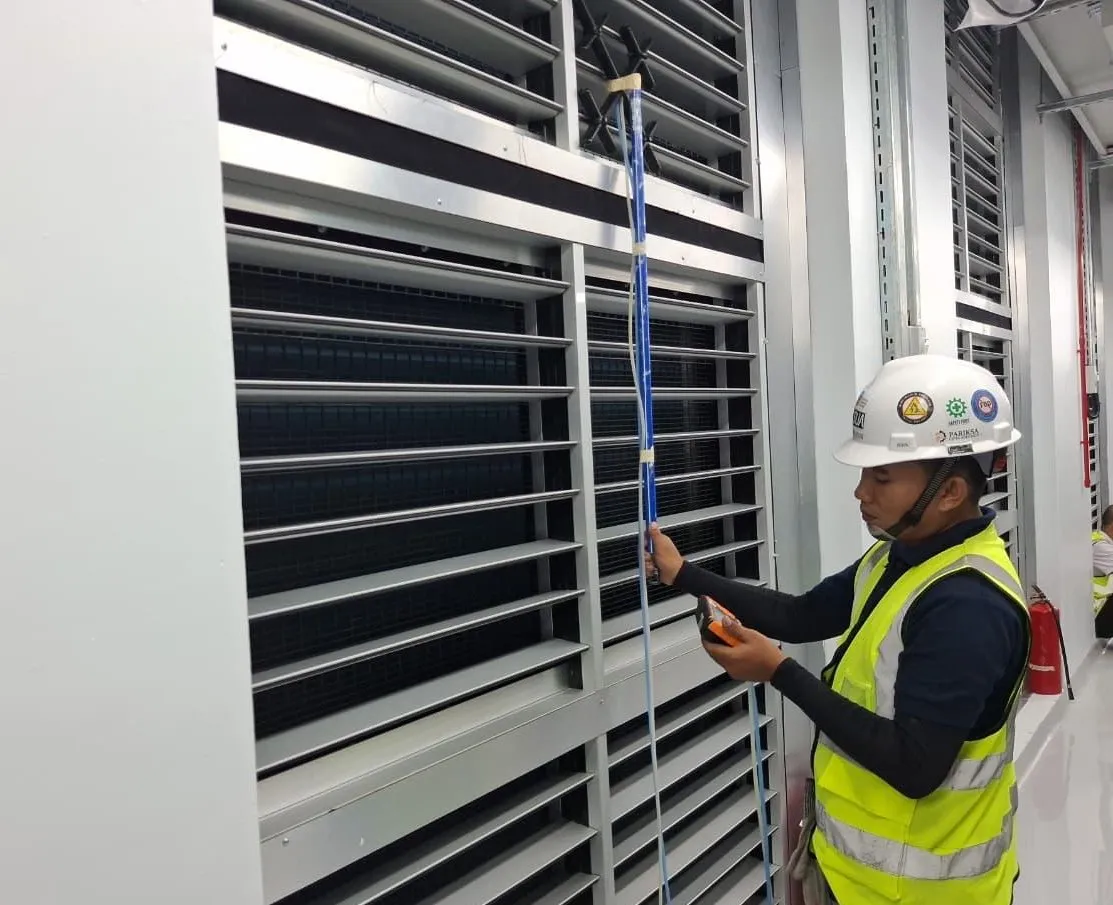
The most reliable check is to choose a sample of terminals yourself and have the tester measure them again while you watch, using the same instrument with the system in the same mode as in the report. Pick the sample rather than letting the tester pick it, and include the terminals furthest from the fan, the ones at the edge of the tolerance and at least one on each air handling unit.
The new readings will not match the report exactly, but they should sit close to the recorded values and inside the tolerance. If several are well off, find out whether the system has changed since balancing, such as a controls setpoint or a filter change, or whether the readings were never taken, and either way that part of the report has to be repeated.
It also helps to look at the dampers themselves. Proportional balancing sets each terminal to the same percentage of its design flow, working from the least favoured branch, so the dampers nearest the fan end up partly closed with their positions marked, and a run of wide open dampers close to the fan suggests the system was never really balanced.
Questions about TAB reports
Which deficiencies should the report list?
Anything that stopped a terminal, branch or unit reaching design, such as a damper that is missing, stuck or out of reach, a fan short of duty, an undersized branch or a drawing that does not match the installation. Each entry should give the location, the reading, the likely cause, the recommended action and who is responsible for closing it.
How can you tell readings were copied from design values?
Copied readings sit exactly on design or repeat the same small offsets across many terminals, while real readings scatter unevenly within the tolerance. Remeasuring a few of the suspect terminals settles the question faster than any amount of desk review.
What do the air handling unit sheets show?
The supply, return and outside air flows, the fan speed, the motor current or power and the static pressures across the fan, filters and coil, each beside its scheduled value. They show whether the unit has margin left and whether the outside air quantity matches the design, which the terminal sheets cannot tell you.
Is a low reading at one diffuser a terminal problem or an upstream one?
Look at its neighbours on the same branch, because if they are low too the cause is upstream, such as a branch damper, a leaking duct or the fan itself. If only that diffuser is low, check its own damper, its flexible connection and its blade setting.
What calibration details should the instruments list show?
The instrument type, make, model and serial number, the date of its last calibration, the date the next one is due and who calibrated it, ideally with a certificate number you can ask to see. The calibration of every instrument should have been current on the dates its readings were taken.
Book testing and balancing
Send the drawings, the flow schedule and your target dates, and we'll reply with a test plan and a quote.